0.000000
0.000000
Posted in Uncategorized | Leave a Comment »
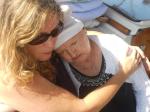
“ One of my experiences in those first weeks – and I kept experiencing it to a diminishing degree through the ensuing months – was a feeling of being a smaller, lesser, more inconsequential person than I had been when she was alive. Her loss made me feel less substantial, or more naked. I had never recognized until then how she had amplified me, reflected me back and made me more believable to myself. That had developed so gradually through our years together that I had never noticed it, but when she was no longer there I suddenly felt – it’s hard to put into words – flimsy.” William Bridges, The Way of Transition” (Bridges is writing about the death of his wife, Mondi.)
My mother died at 4:20 on a Sunday morning in November. I was stroking her face and singing her a love song when she gently slipped away. It was as though I had sung her to sleep, and for that comfort, I will be eternally grateful.
My heart is too full of grief and love and regret and gratitude to make room for my brain to fully process this experience yet or to find the words to share with you what is running through my mind and body right now. What strikes me the most today is that while I have experienced the heavy-heartedness of loss and grief before, never has my heart been this heavy, so leaden that I am absolutely exhausted carrying it around.
In Swamplands of the Soul: New Life in Dismal Places, James Hollis observes, “The word ‘grief’ derives from the Latin gravis, ‘to bear,’ and from which we get our word ‘gravity.’ To experience grief is not only to bear the heaviness of the condition but, again, to testify to depth as well.” The gravity of my grief leads me down into the depths of both my longing and my love. One moment I am strong; I am the comforter; the matriarch, and the next, I am weeping without warning — a motherless child, a woman underwater struggling for air.
Hollis also wrote, “When we lose a loved one, we need to grieve that loss and yet consciously value what we have internalized from that person. The parent who suffers the empty nest syndrome, for example, suffers less the loss of the child than the implicit identity which went with being that child’s parent. The energy invested in that role is now available for a different direction. So, we honor best those we have lost by making their contribution to our lives conscious, living with that value deliberately, and incorporating that value in the ongoing life enterprise. This is the proper conversion of inescapable loss into this evanescent life. Such conversion is not denial but transformation. Nothing which is internalized is ever lost. Even in loss, then, something soulful remains.”
I am Brenda Byram’s daughter and it suddenly occurs to me that perhaps part of the heaviness I am experiencing now is the weight of my inheritance, the riches that I carry forward in this life. My mother taught me so much about what it is to love, about how to listen deeply, to be generous, to recognize the beauty that exists within friends and strangers alike, to hear what was left unspoken, and how to make of myself a safe harbor that gently welcomes and provides shelter and sustenance.
While her childhood had been painful enough to break both of our hearts, and the canvas of her life contained a mad mix of both light and darkness, it was art at its finest – complex, authentic and beautiful. And I am still working through the vast array of lessons contained within the multitude of stories that made up my mother’s life and death.
Following her mother’s death Deborah Sumner wrote, “My fear is that I lost more than my mom; I lost an ally, a protector, a counselor, and a confidante. Even though she’s not physically here, she’s still a huge part of who I am. I have all her years of wisdom and advice to look back on and tap into when I need it, and that gives me strength to face my fear.”
Once I was asked to answer quickly and without thinking what I was good at, and I was startled by the immediacy and intensity of my response. I answered, “I am good at love.” It’s what my mother taught me how to do best – how to love. Thank you, Mom. I love you now and always….
Posted in cancer, grief | Tagged death, death and dying, death of mother, grief, loss | 5 Comments »

On October 12th I am honored to be joining author and theologian, Marjorie Zoet Bankson, at the Center for Wisdom’s Women in Lewiston to share stories about our lives and how we came to discover and follow our callings. The event is called Wise and Strong Women Speak
Normally I don’t publicly announce when I do such events however I would so love for women who live in the Lewiston Auburn area to come and visit this wonderful center, a sacred and safe place which nurtures, empowers, teaches, and supports women.
The center is located at 97 Blake Street between Pine and Ash Street and just one block from the city post office,and Kennedy Park, and a two block walk from the city bus station stop.
Posted in Uncategorized | Leave a Comment »

Within the past year I’ve reduced my carbon footprint and my work hours while increasing the number of hours I volunteer and engage in mindfulness meditation. I take a water aerobics class and have resumed my journal practice. Still, I consume too much fat and sugar, worry too much, and don’t eat enough fruits and vegtables or exercise enough. Sufficient self care is time consuming and requires a level of commitment and motivation that I don’t always muster.
And so yesterday I decided to conduct an experiment. I signed up for the 10 day free trial with Gaiam TV. I like the idea of having hundreds of videos on exercise, yoga, and meditation at my finger tips and documentaries, films, and interviews that promote emotional, spiritual, and psychological growth and well-being just a click away. Yesterday (day one of my 10 day trial) I took a tai chi class in the comfort of my living room and watched a thought provoking documentary on life and death. Today, I did twenty minutes worth of dancercize before heading off to visit a friend. For the next 8 mornings I’m planning on doing yoga, qigong, aerobics, pilates and strenght training. I’m also looking forward to relaxing at the end of the day with films on compassion, personal development, health and wellness, spirituality, and more. As always, looking for more ways to follow the door mouse’s advice (remember the old song, “go ask Alice?”) to “feed your head.”
Posted in health, Inspiration, mental health, Uncategorized, wisdom | Tagged Gaiam TV, health and wellness | 3 Comments »
I went to a reading last night held at Bates College by Brian Turner, award winning poet and veteran of the Iraq war. (He’ll be at the Lewiston public library tonight for those of you who live in the Lewiston/Auburn area.) After the reading someone asked him a question about healing and his response was one that I plan on mulling over for some time. He suggested that perhaps the appropriate goal of veterans (trauma victim/survivor?) is not to heal from their wounds but rather to learn to integrate them into the rest of their lives. From a narrative therapy perspective, I wonder if he meant that the wounds of war must be woven into the larger story of the veteran’s life, and while certainly a defining chapter in the overall narrative, must not become THE ENTIRE STORY.
I was moved by his poetry, and when I returned home I couldn’t put his book, “Here, Bullet” down. I read it from beginning to end and didn’t sleep until night had given way to the fledgling hours of morning. I was revisited once again by the jagged and shattering stories shared with me by the veterans with whom I’ve worked over the years, the haunting beckoned this time by the horror and heartbreak of war transformed into poetry.
I found a quote in an old journal entry by veteran, Timothy Kudo, who wrote, “ I thought my war was over, but it followed me. It followed all of us. We returned only to find that it was waiting here the entire time and will always be with us. “ And I acknowledged then that in some ways, the war will never end for me either, for any of those of us who have served as inadequate and yet fully present witnesses. I honor in my heart and in my own tortured memory – the boy, the girl, the wounded warrior and the poet that lives on in each and every one of them….
Posted in healing, Poetry, PTSD, trauma, War | Tagged poetry, PTSD, War | Leave a Comment »
Here’s a video that celebrates all of those wonderful square pegs making their way in a round world, each and every one of us…..
Posted in awe and wonder, Inspiration, Uncategorized | Tagged inspiration | 1 Comment »

The following is a poem by wise and compassionate poet, counselor, and retired Episcopal priest, Alla Renee Bozrath that I first discovered in the book, “Life Prayers: 365 Prayers, Blessings and Affirmations to Celebrate the Human Journey” edited by Elizabeth Roberts and Elias Amidon. If you are a seeker, a griever, or are struggling in any way right now, I encourage you to explore her wonderful work.
“Don’t look back,
battered child,
Time then hurt you,
Let time heal you.
Don’t look back.
Don’t look back,
beaten child.
They knew not what
they did except what
was done unto them.
Don’t look back.
Don’t look back,
abandoned child,
abused, neglected child.
Denial is salt in your wounds.
Dwelling in repeating
the deliberate disappearance
of your soul.
Don’t perpetuate this harm.
Break the cycle,
wait –
stop it here.
Speak out the paralyzing secret
and begin to come back to yourself.
Cry it out to compassionate ears
and be held in the hearts of your witnesses.
The truth shall make you free
but first it will shatter you.
What was broken can be mended,
what was lost, restored.
Find yourself, then,
pure and whole, a child of God.
Look back long enough to let go.”
– Alla Renee Bozarth
Look Back
Long Enough
and then
Let Go…..
Posted in childhood abuse, childhood suffering, healing, healing recovery, hope, women | Tagged childhood abuse, healing, Hope, recovery, transformation | 3 Comments »
In the above TED talk Eva Ensler, creator of the “Vagina Monologues” speaks about the power, wisdom, compassion and exploitation of girls and urges us to value and embrace the “girl cell” that exists within each of us.
Posted in women | Tagged abuse of girls, abuse of women, compassion, girl power, girls, the abuse of women, women | Leave a Comment »
-
Recent Posts
Categories
Archives
Pages
-
Join 142 other subscribers
Tammie’s Tweets
Tweets by mainetherapistShare This Blog

SagePlace: Creating the Life You Love
Top Rated
 Spirituality, Therapy, and the Good Life