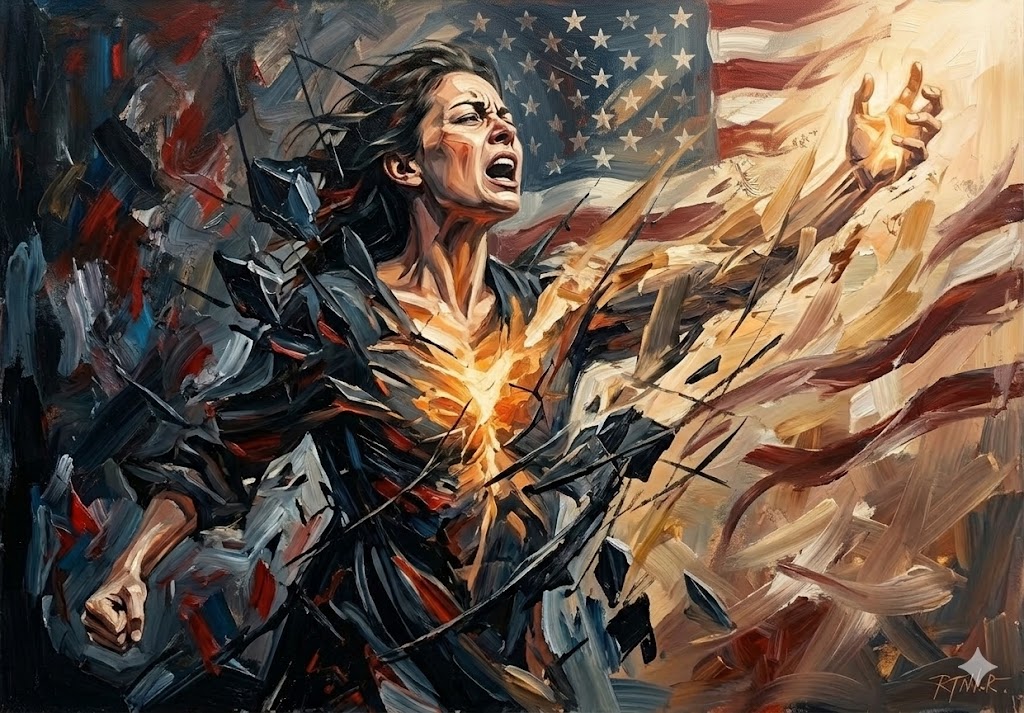
Twenty‑five years ago, I finished my book, BirthQuake: The Journey to Wholeness. In it I described a transformational process “where everything is rocked and shifted, where foundations crack and treasures lie buried beneath the rubble.” At its heart, the book explored what we now call post‑traumatic growth—a term I didn’t yet know, but a process I felt in my bones.
Today, I’m struck by the parallels between what I was writing then and what’s unfolding now in my country. It feels like an almost eerie reminder that our experiences—especially the difficult ones—are always preparing us for something ahead. Each upheaval carries lessons that reveal their purpose only in hindsight.
I divided the BirthQuake process into four phases:
1. The Quake
2. Exploration and Integration
3. Movement
4. Transformation
Today, these phases seem to echo far beyond individual lives, mirroring the tremors shaking our country and the world.
The Quake
A quake begins with rupture. Something tears open—suddenly, violently, or sometimes so gradually that we don’t realize the shift until the ground gives way beneath us. The familiar becomes unfamiliar. The structures we trusted reveal their fractures. What once felt solid now feels precarious.
In a personal quake, we experience profound uncertainty. Questions multiply. Answers evaporate. We become disoriented, frightened, vulnerable, and often angry. Grief rises not as a single emotion but as a constellation of losses:
• the loss of identity
• the loss of stability
• the loss of the life we believed we were living
Although quakes often erupt within individual lives, they can also shake families, communities, and entire nations. And today, many of us in the United States feel that we are living through a quake of worldwide proportions.
Just as a personal quake shakes the inner architecture of a life, our country is experiencing a shaking of its civic foundations:
• Long‑held norms feel fragile.
• Institutions once assumed to be unshakeable now appear alarmingly vulnerable.
• Truth itself feels contested, stretched, or distorted.
And with this shaking comes grief—deep, bewildering grief. We grieve:
• the erosion of shared reality
• the rise of political extremism
• the fraying of social trust
• the sense that the country we believed in—or at least took for granted—is slipping away
It’s the same grief that comes when a life you thought you understood suddenly breaks open.
A quake isn’t merely a disruption.
A quake is a wake‑up call.
Exploration and Integration (Initiation)
Every quake, personal or collective, carries a dual message:
Wake up. Pay attention. Something essential is being revealed.
In personal transformation, the quake exposes illusions—about control, identity, relationships, and the stories we tell ourselves.
For a nation, the quake exposes illusions about:
• the inevitability of democracy
• the stability of institutions
• the belief that progress is linear
• the assumption that “it can’t happen here”
Therapist and author Bill Plotkin describes a crisis as a “pull toward soul,” a force that drags us toward deeper truth whether we feel ready or not. He writes that this pull is like “an earthquake in the midst of your life.” And he’s right: a quake doesn’t just break—it summons.
It shakes loose what’s false.
It reveals what’s been buried.
It demands that we pay attention to what truly matters.
A national quake pulls a country toward its deeper questions:
• Who are we, really?
• What do we stand for?
• What are we willing to protect?
• What are we willing to lose?
• What must be transformed for us to survive?
This is soul work on a collective scale.
And like all soul work, it’s uncomfortable, disorienting, and necessary.
Movement
In a personal quake, treasures lie buried beneath the rubble—truths, strengths, and capacities that might never have emerged without the shaking. The same is true for a nation.
Moments of democratic crisis have historically revealed:
• new movements
• new coalitions
• new moral clarity
• new forms of courage
• new commitments to justice and truth
The quake exposes what’s broken, but it also reveals what’s worth rebuilding.
It shows us where the fractures are—and where the light gets in.
Movement begins when we stop clinging to what was and start engaging with what is emerging. It’s the phase where grief begins to metabolize into purpose, and fear begins to transform into agency.
Transformation
Just as a personal quake calls someone out of autopilot, a national quake calls citizens out of complacency. It urges:
• vigilance
• discernment
• courage
• participation
• solidarity
• moral imagination
It asks us to become stewards of democracy rather than passive beneficiaries of it.
From the perspective of someone deeply troubled by the current threats to democracy, the parallel is unmistakable:
Our country is Quaking.
The shaking is real.
The grief is real.
The danger is real.
But so is the possibility.
Transformation is never just a breaking.
It’s a summoning.
A call to awaken.
A call to protect what matters.
A call to become wiser, braver, more conscious participants in a country approaching its 250th year—and still being shaped, even now, by the choices we make.
A BirthQuake isn’t an end of a story.
It’s the beginning of a deeper one.

 Spirituality, Therapy, and the Good Life